Sunday Telegraph "The leaves were exceptionally good".
Anneka Rice on Radio 2 - "Almost too beautiful to eat"
Showing posts with label Organic Gardening. Show all posts

Friday, 22 March 2013

The Die Hards - Out in the cold wearing just a Persil white vest.....
                     A wee blog on winter salad
Whilst salad is generally associated with the balmy days of summer (obviously not in the UK!) there are several salad plants which not only enjoy our winters but positively thrive on them.
Poly in the snow.
They need no heat and will pretty happily grow outside in winter or in a cold greenhouse if you like to pamper them. Having said that I do live in the girly south so perhaps a cold greenhouse is preferable to outside under a fleece if you live
north of Brizzle. Here at Maddocks Farm we manage to organically produce year round salads using unheated polytunnels, outdoor beds and a very large pile of fleece.
Lettuce
When it comes to lettuce sometimes the clue is in the name. Lettuce called Arctic King, Winter Density or Marvel of 4 Seasons generally do what they says on the tin. I have found, even in Devon, that there is little point having lettuce outside the tunnels in winter if you are an organic grower. Lettuce will survive under fleece but will be ravaged by every slug/snail out wearing thermals and won't thrive until April time when it will leap into action. In reality it is better to manure the bed over winter and then plant out new babies in late March under a couple of layers of fleece.  Ours went in outside under a double layer of fleece a couple of weeks back and apart from checking for slug damage they will be left undisturbed for a few weeks. In protected tunnels winter hardy lettuce produce a steady stream of leaves all winter.
Lambs lettuce
Corn Salad, Lambs Lettuce or Mache
Whatever you like to call it it,  Lambs Lettuce is the Bruce Willis of winter "lettuce". On a negative side it has small leaves that for some reason seem to attract dirt like Spot the Dog and in my personal view has a slightly wooly texture in the mouth but on a positive note they has a fabulous fragrant spinachy flavour and will grow outside without cover from October through until March or April when the plants erupt into pretty white edible flowers and seed themselves everywhere. During winter you can use the cut and come again technique to get several crops of lovely fresh green. Perfect!
Winter purslane flowers
Winter Purslane is a favourite both with me and the slugs. Teardrop shaped leaves followed by lovely mild cucumber flavoured flowers. Crunchy, fresh and if it doesn't sound daft really "green" flavoured. A brilliant cut and come again.  Seeds itself prolifically to lie dormant all summer and pop up in the beds around late September to thrive through the winter. Doesn't get better than this.

Mustards
Green in the Snow with Lambs Lettuce behind
There are a lot of spicy leaves which do well over winter in an unheated polytunnel including Giant Red Mustard, Golden Streak and Wild Rocket but outside three will thrive down here. The most prolific of them all is Green in the Snow (see - back to does what it says on the tin!). It is also a bit of a dirt magnet but even in the harshest conditions thaws out a treat during the day and sends up lovely little spears of spicy perfection which are hot enough to rival horseradish and which will just keep on going all winter. Here photographed a few weeks back with Lambs Lettuce behind. Come April it will be covered in lovely edible yellow flowers (beloved by the bees) and then self seed. Salad rocket will also seed itself well to suddenly make an appearance in February with tiny seedlings that don't look strong enough to cope with the cold but which hunker down to produce prolific leafy loveliness in April. The last to cope will outside with a fleece tunnel is American Land Cress which can get a bit robust and tough but cut back hard will produce lovely cress flavoured leaves for weeks over winter and early spring.
Sorrel piercing the snow.
Herbs
As well as the winter purslane mentioned above, four herbs struggle on in a manly fashion over the british winter. Well, it would be more honest to say that they give up partying last in winter and are then first up for coffee in the morning.  The hardiest of them all is the sorrel which starts pearcing the snow with arrow head of tangy freshness as early as the beginning of February and if picked hard will continue to produce sharp lemon blades until a Spring sowing comes to the rescue. Chives are another herb that heralds the start of Spring and bring a lovely oniony tang to early salad. Flat leaf parsley also keeps going over winter producing a few leaves here and then and then suddenly leaps into action with frilly freshness at the beginning of March. Coriander is surprisingly hardy and will sulk in a bed over winter to suddenly flush into new growth in late February.

Chervil won't do so well outside but will happily grow in an unheated bed in a poly tunnel and bring a sophisticated hit of frondy aniseed to any winter salad.
Chives in early February
Flat leaf parsley in the frost

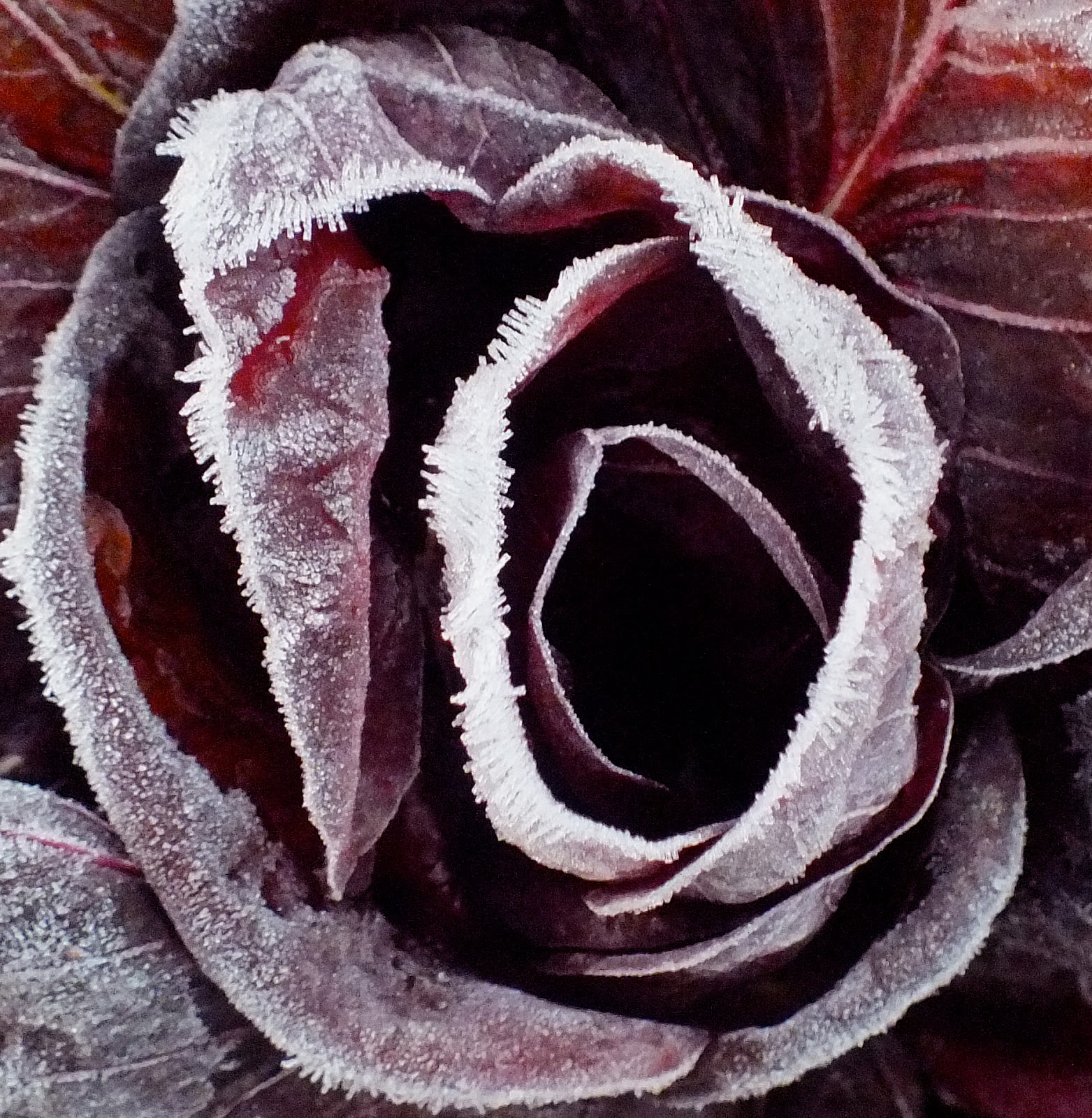
Frosty radicchio
Red ribbed dandelion
There are two additions which add a bit of winter colour to the bowl. One is red ribbed dandelion which brings some bitter endive taste and the other is radicchio. If you leave the stumps of your autumn crop in the ground then you are rewarded with perfect rosettes of regrowth around the base in early spring which will cope with any amount of cold but rot if they get too wet. Be warned they also act as slug hotels over winter to check them carefully.
Salad picked 7th March for Mothers' Day
Others that you can add to the pick & mix are swiss chard, winter spinach and baby kale leaves as well as wild garlic in early Spring. This Mothers' day salad is also decorated with the earliest of the edible flowers violas and primulas.






Sunday, 18 March 2012

Rejoice in the return of the redheads!

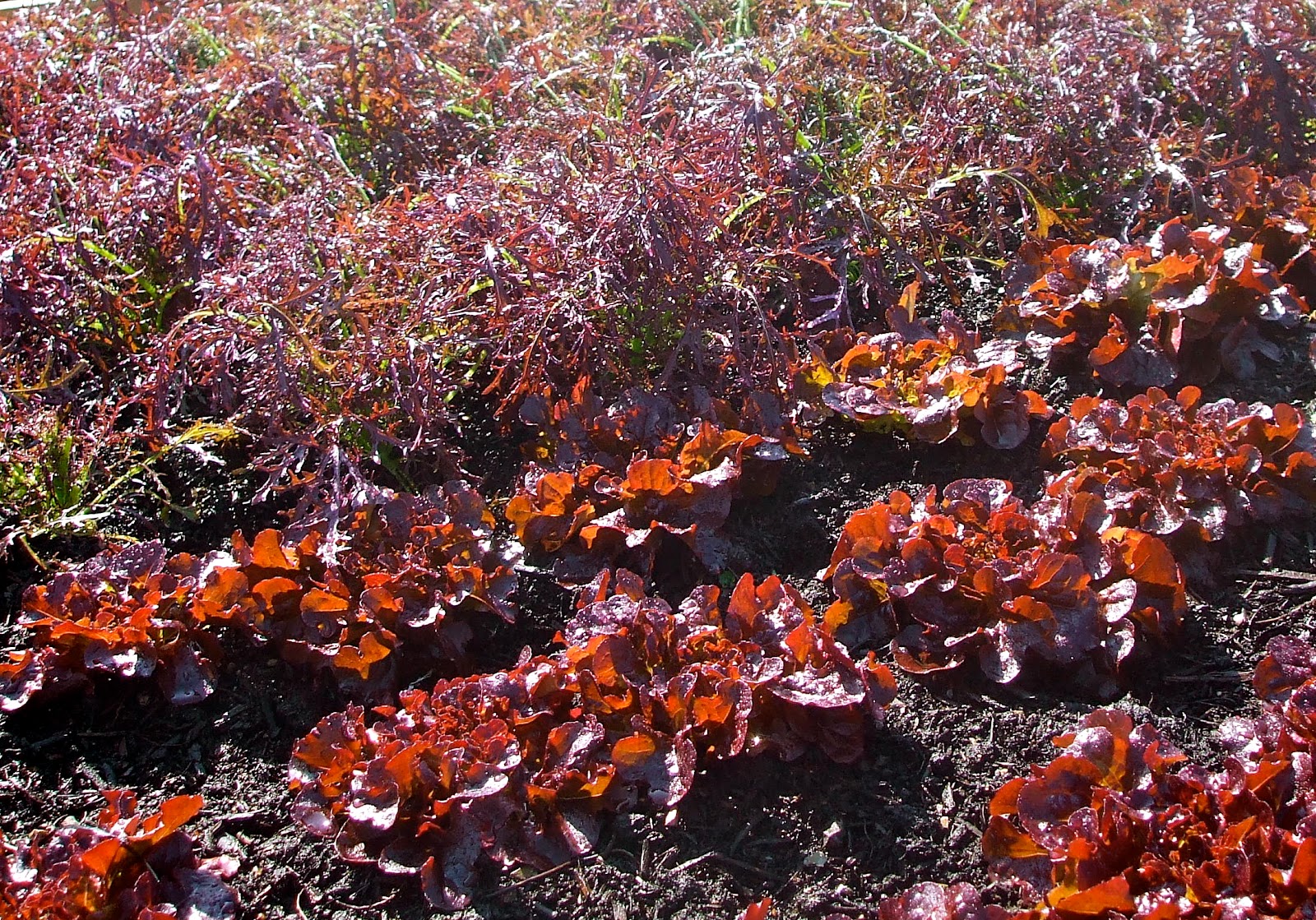
Red oakleaf lettuce and red frills mustard

The middle of March heralds the return of the red heads to the salad palette and it is great to see them back. Over the winter the low light levels result in the red lettuce leaves fading to muted brown and even the red frills mustard settles to a gentle maroon.


There are little excuses of colour here and there with the ruby chard,  the red stemmed radish and similar red stemmed dandelions but even they are shadows of their summer selves and they are really just a tease.


Red and green compliment each other to perfection in a salad
But with the Spring Equinox on the horizon and
the competition between daylight and darkness
finally tipping in our favour,  the colours start
flooding back into the leaves and they literally
zing with vibrancy.


I like to reassure myself that my three years at art college were not a complete waste of time in the fact that I know my way around a colour wheel. Green and red appearing on opposite sides of the wheel makes them visually complimentary - a fact that old mother natures works repeatedly to her advantage. 


Treviso chicory
The real Rhiannas of the  red headed salad world are the chicories and in particular Treviso and Radicchio. It doesn't really matter if you love or loathe the bitter taste of these chicories, there is something about their vivid appearance in a bowl of salad which harmonises the whole and makes the salad look fresher and more alive.

This Treviso has overwintered in our polytunnels beautifully and the radicchio outside are regrowing stubby little babies around their crowns. I am going to relish these over the next few weeks because the warm weather will inevitably make them bolt and we will then have a hiatus until they appear back in our salad bowls in late summer. (Radicchio and other chicories react to the lengthening summer days and will bolt if they are sown more than a couple of weeks before the summer solstice. After that time they will happily grow and fatten to give us luscious luminosity in our salads all the way through to winter).


Monday, 20 February 2012

Sowing Marmite.........

Once you move away from limp iceberg and start offering customers fresh and flavoursome leaves in their salad bags you  open up a whole can of worms (Well - not literally. Well - hopefully not at all).

The first reaction from customers is to comment on how long the leaves stay fresh in the fridge. One customer came rushing up to me and said that she had had her bag in the fridge for 9 days and it was good as new. Whilst I smiled externally, internally I was mulling over why, if she liked it so much, it hadn't occurred to her to eat it!

The second reaction is the look. Every single one of our salads arrives at its destination on the day that it is picked  - even if that day starts before 5 and finishes at 10! The leaves are hand picked, in small batches, and brought in quickly to be washed. Our salads are a riot of colour and most are finished with edible flowers. I like to think that the three years that I spent at art college weren't a complete waste of time and I am really lucky that the people that work with me pay the same attention to detail to ensuring that the salads look beautiful. So many people eat with their eyes and comment on how lovely the salad bags look.

However, the overwhelming reaction from people is because of the flavours. I strongly believe that this is partly due to the fact that we are certified organic and therefore the product is as natural as it gets. I also think that allowing leaves to develop at their own pace, rather than being forced, allows the flavours to mature. Growing in season also affects this tremendously.

That being said however, the over riding reason for the flavour hit is the amount of different leaves that we pack into our salads.  Throughout the year we grow:  11 varieties of lettuce; 5 of chicory; 5 of spinach & beets; 3 of cress; 3 of rocket; 6 of mustard; 2 of peas; 13 of herbs and about 6 non classifiable bits and pieces that just should be in there. There are also wild pickings which make their way into the bags and the list increases each year.

Picking, washing, bagging and distributing these leaves by hand and quickly means that often the salads are eaten on the same day and the people become quite obsessional about the aromatic and fresh flavours. More and more frequently I send boxes of mixed leaves overnight to London and further afield.

Coriander - the marmite of the salad world?
This reaction can go two ways of course. It is not usual for  people to come up to me at the Farmers' Market, with a small plastic bags containing a particular leaf which they would like identified as they either love it (and want to grow it) or hate it. Chefs phone wanting 300 pieces of 'that  little pink or white leaf' for a garnish for a particular dish.

Pet loves and hates include those leaves with a strong aniseed flavour such as chervil, fennel or dill; another reaction comes from the really hot mustards - one chef (who shall remain nameless) asked me to increase the percentage of  spicy leaves to accompany a steak dish and he then phoned me at 10 at night laughing to suggest that we needed to tame it down a bit as a man had gone purple eating Giant Red Mustard in his restaurant.   Lambs Lettuce can evoke a strong response more because of the texture than the flavour.

However the most hotly debated of the salad ingredients is Coriander - it is definitely the marmite of the salad world. People genuinely either love it or hate it. I love it and can't see that it has a particuarly strong or offensive flavour but quite a few customers order Herb Salad 'but hold the coriander'. It is also one that we are quite often asked to leave out of a wedding mix.

We are lucky in that we are still (and intend to remain) a small and personal company which hand picks everything to order. My large black order book specifies what goes in each mix so that customers can choose exactly what they would like but who would have thought that the humble salad could evoke such strong reactions?

Saturday, 28 January 2012

Watercress - does it realise that this is January?

Stunning January watercress

The watercress in the polytunnel is putting on April growth in January as a reaction to this incredibly mild winter and this is a really welcome addition to the early salads. 

At this time of year our salads usually comprise 30% lettuce, 20% lambs lettuce and a mixture of spicy mustards balanced by milder baby leaf spinach, winter purslane and mizuna.

This year is completely different. The winter hardy lettuces are struggling with the warm damp  weather. The polytunnel doors have barely been shut to keep the air flowing but the lettuces have struggled with mildew and rotting off despite not watering. Likewise, outside the lambs lettuce is suffering with mildew and slug damage and the effort in cutting smaller and smaller leaves make it hardly worth the effort.

We have never bothered to grow watercress through our stream because of the concern with liver fluke and we are also excessively cautious not to manure any of the beds that we are going to use for watercress production. Beyond that we have found that watercress grows fantastically well if just planted in a raised vegetable bed and kept well watered. It grows particularly successfully in early spring and late autumn and is incredibly prolific. If growing early outside it works effectively with a clear sheet of plastic over the top to protect from the frost and this seems more effective than fleece because it also retains the moisture which watercress loves.

As with a lot of things there is no comparison between shop bought watercress and homegrown for both crunch and flavour. Watercress flavour tends to deteriorate from the time that it is picked. Initially when it's first cut it can be up there with horseradish in heat but two or three days in the fridge will render it pretty bland.

On the downside watercress is a veritable magnet for flea beetle in the summer. Fleecing, enviromesh, nothing works. They will find a way in somehow. This last year we used this to our advantage by growing two or three watercress plants at the ends of a bed of wild rocket. The  sacrificial watercress was smothered with holes and beetle and we treated it  with diatomaceous earth. The wild rocket was completely untouched.

We let our early outside crop of watercress flower and seed before clearing the bed and planting summer lettuce and find that come mid autumn the residual watercress seed germinates and we get a crop that will last us through until the first hard frost (yet to happen this year).

Definitely worth growing. 

Wednesday, 18 January 2012

Globe Artichoke - Unlikely January Star

The Globe Artichoke is an unusual star for January but during the last few days, as temperatures have dipped, the artichoke patch has been a flurry as a variety of garden birds have pulled the chokes apart to reach the tasty oil rich seeds.
Another bonus is that Globe Artichokes retain some three dimensional interest in a vegetable plot into winter, long after the bean poles have been put away, as well as being stunning architectural beauties when dusted with snow or frost.

We traditionally leave the old growth in the artichoke patch for the birds and clear it in late spring but this year I have also left two other beds to seed/stand over winter - one of Red Frills Mustard and one of Red Amaranth. As with the artichokes, both beds have been busy with birds pecking at the seeds with the Red Amaranth in particular being covered in finches and tits.
My reasons weren't completely altruistic however. Primarily I wanted to see how early in the year any dropped seeds would germinate and if they would provide me with an early crop before burning the over winter growth off. Of course I wasn't allowing for this mild winter and the red frills germinated in early December and has subsequently been mowed by slugs and the Red Amaranth has germinated this week and I suspect will fall foul of the frosts of the last few nights but we will see.

Back to the Globe Artichokes.... the new growth is already pushing lushly through the soil and making promises of a summer feast of roasted 'chokes on wood fired pizzas, or more traditionally served boiled whole with hollandaise sauce or salty tarragon butter.

Artichokes are the epitomy of a great natural 'slow' food requiring getting stuck in with hands; oily fingers; warm bread to mop  - the whole tactile joy of eating which seems too time consuming to be anything other than a luxury now. They are also brilliant for the liver, which is a bonus if they are washed down with a couple of glasses of chilled white wine!

Artichoke plants attract ladybirds in profusion,  drawn to aphids that tend to accumulate at the fleshy base of the 'chokes.We find that the ladybirds feed, breed and overwinter hidden in the remaining heads or in the hollow stems and the plants are therefore a really valuable addition to an organic plot.

In late summer the green sphere split open to reveal purple flowers which become so laden with nectar  and pollen that they literally vibrate with the buzzing of bees and other insects which in another fabulous bonus for an organic grower.

So, Globe Artichokes are in reality a year round star. They feed us, pollinating and predatory insects and overwintering birds as well as providing year round beauty and structure in the garden. A perfect plant.

Monday, 9 January 2012

Star of the week


Red Stemmed Radish 

Pods of leaf radish are full of
flavour if picked small.

Leaf radish flowers. Edible & beautiful

The star of week one is red stemmed leaf radish Sai Sai which is flowering unseasonably early in our Devon field.

The leaf radish is a fantastic plant. It germinates well and suffers little from pests and diseases if planted in cool seasons. The leaves have a vibrant red stem and taste of fresh radish rather than pungent mustard. The base forms a large inedible radish but the leaves keep coming all winter if regularly picked. I grow these in the polytunnel but the photo above is taken outside yesterday. The flowers when they come are white or pale pink and keep going for weeks on soft spicy edible stem. Then comes the pods which are fabulous. A wonderful crunch and radish flavour. The plants produce loads of seeds for the following year or will self seed if you let them. What more do you want?