Sunday Telegraph "The leaves were exceptionally good".
Anneka Rice on Radio 2 - "Almost too beautiful to eat"
Showing posts with label Edible Flowers in Savoury Recipes. Show all posts

Wednesday, 24 September 2014

Nasturtium Pesto.

Nasturtium Pesto.


We make a whole host of different pestos at different times of the year here and use them with everything from pasta, new potatoes, on canapés, swirled on soup or simply smeared on a hunk on bread.


This particular nasturtium pesto is lovely using either just leaves, leaves and flowers or just the flowers. Here we’ve used red pesto flowers with charcoal biscuits and goat cheese as a canapé.


Nasturtium Flower Pesto http://maddocksfarmorganics.co.uk/category/nasturtiums/


Ingredients


100 grms of pine nuts (or walnuts or almonds or any nuts that take your fancy)


100grms of good quality parmesan cheese – grated (the best you can get but not pre grated)


200 mlx of light olive oil


2 large handfuls of either nasturtium leaves or flowers or a mixture of both depending upon what colour you’d like your pesto. You can also mix in watercress, rocket, basil or any other scrummy greens.


If you are not adding wild garlic then add a couple of cloves of garlic.


Pinch of sea salt and black pepper to season.


Roughly chop the green by hand until they are quite fine. Grate the parmesan and blitz with the remaining ingredients before thinning with the olive oil.


It it tastes a little claggy (technical term there!) the just add a hint of lemon juice or white wine vinegar to thin.


Nasturtium Pesto http://maddocksfarmorganics.co.uk/category/nasturtiums/


Yum!


http://maddocksfarmorganics.co.uk/category/nasturtiums/


The nasturtium pesto went down very well with a hunk of nasturtium bread when The One Show came to film.


The One Show at www.maddocksfarmorganics. DSCF3692


Nasturtium Pesto.

Wednesday, 20 August 2014

Nasturtium and pumpkin seed bread.

The recipe for this lovely bread comes from Frances Bissell’s new book, The Scented Baker which is available to buy from our website from next week – click here. Advance orders are being taken now. We were honoured that Frances chose Maddocks Farm Organics as her recommended source of edible flowers in her new book and delighted when we were approached to try some of her recipes in advance. What I love about Frances’ approach to edible flowers is that she uses them in recipes rather than just as a garnish on the side. This bread contains both nasturtium flowers and seeds and is fabulous.   DSCF3626 Makes a 1kg/2lb loaf 500grms/1lb strong white flour 2 teaspoons salt 2 teaspoons fast action yeast 2 tablespoons olive oil 300ml/1/2pint of warm water 75grms/3 oz pumpkin seeds 10 nasturtium flowers (I added more as I love to see the bright flecks through the bread) 1 tablespoon fresh nasturtium seeds, chopped Mix all the dry ingredients into a bowl, make a well in the middle and pour in the oil and the water. Draw the flour into the centre and mix well until the dough leaves the sides of the bowl. Once the flour and liquids are combined, quickly work in the petals and seeds. (If you want the petals to look large and more complete the add them towards the end of the kneading process so they don’t break up so much). Turn the dough onto a floured surface and knead it for five minutes. Shape the dough and put it into a lightly greased 1kg/2lb loaf tin. Cover loosely with lightly oiled greased cling film and let it rise in a moderately warm place for about an hour, by which time it should have doubled in size. Bake for about 35 to 40 minutes in an oven pre-heated to 200 degree c/400degree F/gas mark 6. Turn the loaf onto a wire rack and cool completely before slicing – if you can bear to wait.  DSCF3660 You can order a box of nasturtium flowers from us here. If you make a note on your order, I am happy to throw in a tablespoon of nasturtium seeds for free. (We are nothing if not generous here!!) :) You can order Frances’ Book here.


Nasturtium and pumpkin seed bread.

Sunday, 25 May 2014

Chive flower vinegar.

Chive flower vinegar at Maddocks Farm Organics
Chive flower vinegar can hardly be called a recipe but it is a beauty to behold.

Ingredients.

White balsamic vinegar

Chive flowers

Beautiful chive flower growing at www.maddocksfarmorganics.co.uk
Balsamic vinegar has a sweet and less astringent flavour than other white vinegars and is simply lovely with the chive flowers. White wine vinegar is also slightly yellow and the colour transformation is not so impressive.

There are two ways of doing this.
Chive flowers just added.

Method 1:

Either decant your white balsamic vinegar into a nice bottle or in my case simply soak off the label.

Remove about 15% -20% of the vinegar out of the bottle and gently shove chive heads down the neck of the bottle using something as delicate as the handle of a wooden spoon. Put as few or as many in as you like but the more flowers involved then the stronger the flavour and colour.

Put to one side and vigorously shake every few hours until the vinegar has turned a stunning 'Barbie' pink and you have a wonderful mild chive flavoured vinegar which makes beautiful salad dress.


Method 2:

Decant your white wine vinegar into a jug and fill with chive flowers. When the flowers have bleached all their colour into the vinegar then strain the pink vinegar into a clean dry bottle.

Obviously the second method produces something more refined but I quite like looking at the chives in the bottle and seeing their colour slowly bleaching out until they remain like ghosts of their former flowery selves.

Drizzled over salad leaves with a sprinkle of sea salt and glug of olive oil to make an incredible flavoured and coloured dressing.

No photoshopping required. Bright pink oniony vinegar. Stunning!


Edible chive flowers at Maddocks Farm Organics. 


Monday, 5 May 2014

Tulip Prawn Cocktail.


The recipe below was given a wee make-over by some lovely friends. Matt Mason head chef  at http://www.jackinthegreen.uk.com/Home took our tulip prawn cocktail and turned it into a Bloody Mary Prawn Cocktail for our demo at http://exeterfoodanddrinkfestival.co.uk. He replaced the cognac with an extremely generous splosh of vodka and added a good grind of celery salt. Delicious. My other lovely friend Marcus Bawdon then took a cracking photo of it when we demoed together at http://www.tobygardenfest.co.uk. His lovely food blog can be found at http://countrywoodsmoke.com and is well worth a visit as he is the king of all things BBQ! Thank you both.


Tulip Prawn Cocktail. Photo by Marcus Bawdon


I have extremely fond memories of the  classic prawn cocktail being served in wine glasses at dinner parties hosted by my parents. The height of sophistication! My mother floated around fancying herself as a bit of a Margo Leadbetter but in reality at an exaggerated 5ft 1inches and with the same spherical stature that I've inherited she more closely resembled Demis Roussos (obviously with less facial hair). Other classics of the 70s menu included an addiction to the newly discovered fondue set and Black Forrest Gateaux!

Either way - I digress but felt that the prawn cocktail could really do with a floral revival.

Ingredients
Serves 4

4 tulip heads (organic )
a couple of big handfuls of mixed salad leaves
400 grms of good quality prawns

Sauce
5 heaped tbsp good mayonnaise
3 teaspoons of ketchup (50/50 ketchup and tomato salsa if you want to mix it up a bit)
a decent shake of Tabasco sauce
a splash of Cognac
a pinch of prapika

Tulips
These must be from your garden (if unsprayed) or bought organically. For eating do not buy from a supermarket, florist, garage or garden centre. This is not me trying to drum up business but a proven fact that the vast majority of cut flowers are fed or sprayed with a cocktail of pesticides and fungicides in order to prolong their shelf life. These chemical do the plants no visible harm but are most definitely not designed for human consumption and could make you very ill indeed•.

Some recipes don't need mucking about with and this is no exception. My only concession to changes in the last 40 years is to offer you the option to add salsa as well as ketchup if you like a bit more bite to your sauce and of course to add a better selection of salad leaves. Well I would,  wouldn't I! Back in the 70s the choice of salad leaves was pretty much restricted to lettuce and so in this recipe I've used a mixture of our watercress, sorrel and pea shoots which work beautifully with the recipe and still offer the crunch.

The only other addition is a splash of Cognac. I read this in a Simon Hopkinson recipe and agree that it does add a little something special to the dish.

Use a sharp knife to remove the stamens and carpel of the tulip (i.e. the inside bits which aren't petals) and cut the outer stem level with the base of the petals. What you should be left with is a ring of petals 'just' held together at the base with a slither of green stem. Tulip petals are quite stiff and in an ideal world you'd like to be able to pull on a petal and have it detach from the base so you can use as a scoop to shovel your prawns with. Pop your tulips in wide rimmed cocktail glasses.

Mix your sauce ingredients (with the exception of the paprika) and then use them to generously coat the prawns.  Fill the bottom third of your tulips with the salad leaves and top up with the prawn mixture. Sprinkle with a little paprika and then serve with a chilled glass of white sauvignon. Back in the day it would probably have been Blue Nun but there are some things definitely not worth getting nostalgic over.


What classic recipes would you like to see revived?


•A note of caution…..

Whilst the general opinion is that all parts of tulips are edible, there is controversy about eating the tulip bulbs and care and research should be taken if you want to eat more than just the petals. (More information can be found at http://www.eattheweeds.com/tulips-famine-food-appetizer-assistant-2/. )

I should also add that (like with many foods) in rare cases some people are allergic to tulips. So if in doubt, nibble a little bit of the petals, spit it out and wait for 30 minutes or so to see you develop any typical symptoms of allergy such as flushing, dizziness, rashes or feeling sick in which case avoid.


Sunday, 27 April 2014

Spicy Flower Canapés

Ingredients

Fudges Fiery & Flavoursome Jalapeño Melts  - or similar spicy cheese biscuit
(I'm not on commission I just love them). 
A good quality goat's cheese - a log rather than a round one;
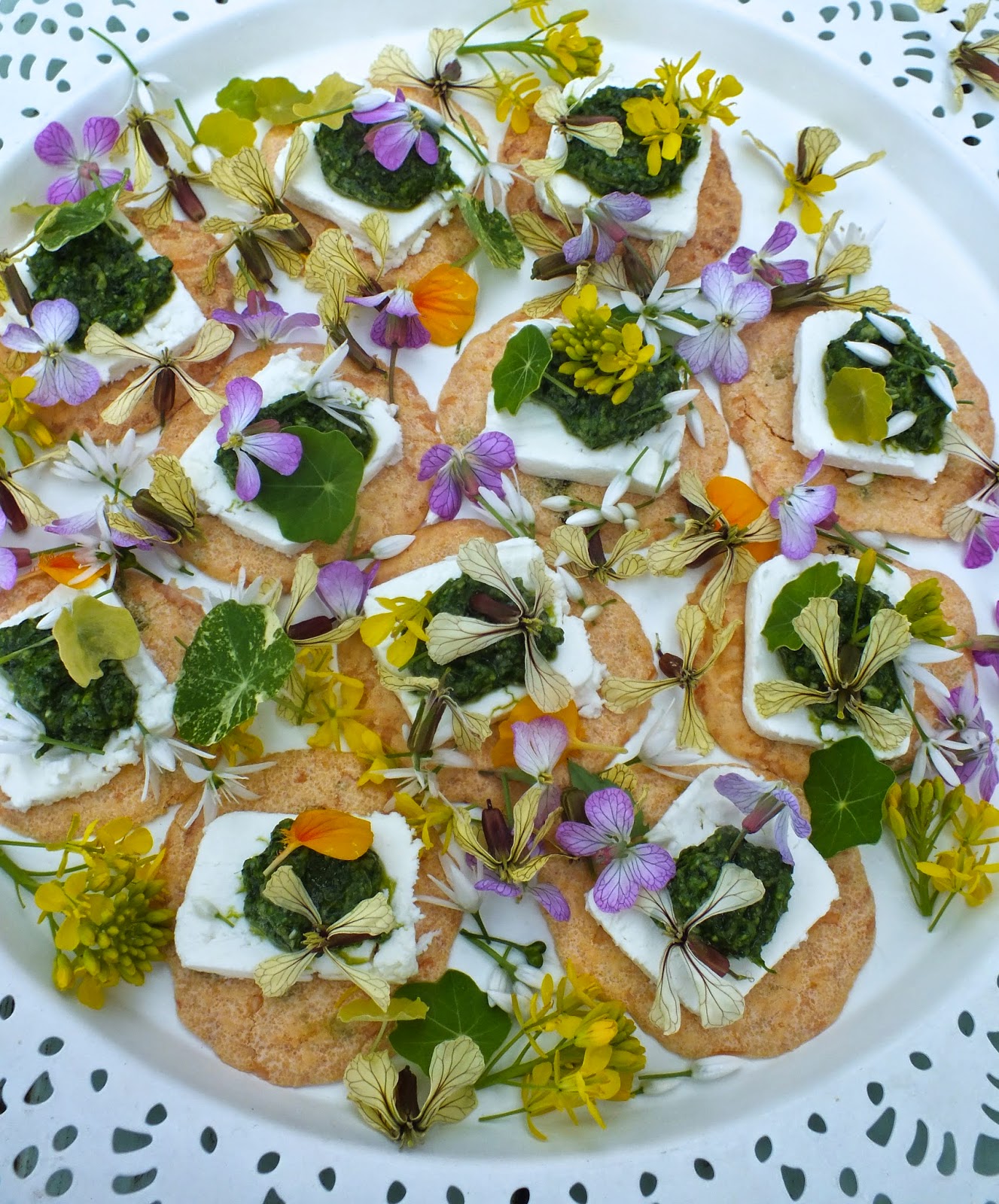
Homemade wild garlic, nasturtium and mustard pesto;
A selection of savoury and spicy edible flowers. Here we used wild garlic, spicy radish, rocket, cress and mustard flowers. 


Rocket flower

Slice your goats cheese into thin slices and add to the cheese biscuits.


Add a generous dollop (technical term) of homemade wild garlic pesto.


Scatter with a selection of savoury and spicy edible flowers - from your garden or from here. Buy savoury and spicy edible flowers

Mustard and wild garlic flowers


Radish flower

Perfecting Pesto

Wild garlic and 'friends' pesto
Photo by Marcus Bawdon


At Maddocks Farm Organics we make our own pesto in the summer due to the massive glut of various basils that we get. Basil can be a bit slow getting going so we always plant far more than we need but once it's up and running it is hard to keep up with and we always end up with far too much by the end of the season.

For me the main bonus of pesto is that it is extremely easy and quick to make and all the ingredients that you need are either in the garden or items that you'd have in the store cupboard or fridge.  A necessity at the end of a long day's picking or planting. Also, it is extremely versatile. Apart from stirring through pasta, we bung it on flat breads and pizzas, slather new potatoes with it and dollop it on meat, fish or veggies. It also pretty good in a sandwich with a freshly picked tomato.

We've now extended our pesto making to other seasons and other ingredients and this time of year is perfect with wild garlic in abundance which forms a lovely base to be partnered with a whole host of spring time additions.

Wild garlic in the rain at Maddocks Farm Organics
This weekend I was fortunate enough to be invited by Darts Farm to do a demo at Exeter Food Festival with the lovely Matt Mason from The Jack in the Green pub in Rockbeare. I'm very lucky to have been working with Matt and his lovely team for a couple of years now and they are a joy to supply because they all are passionate about good local seasonal ingredients and unfailingly good humoured. Part of our demo comprised Matt cooking a 'big boy' steak accompanied by wild garlic, nasturtium and basil pesto and served with a selection of our spicy salad leaves and edible flowers. I'm sure it was delicious but I will never know as the audience descended like a swarm of hungry locusts leaving just the bone rattling around an empty plate. So when I got home I announced to Long Suffering Stu that we were having steak and pesto for supper.

Given the glut of ingredients outside and being too knackered to head to a supermarket I decided that basil 'was for girls' and made my pesto out of 1/3rd wild garlic (leaves, flowers, stems the lot); 1/3 nasturtium leaves and 1/3 giant red mustard - again leaves, shoots and flowers. Don't be afraid of adding quite spicy leaves. Our giant red mustard at this time of year brings tears to the eyes and an acute burning sensation to the nostrils but when added to the pesto it settles to a gentle warmth.
Wild garlic, giant red mustard, nasturtium leaves and edible flowers all heading for the pesto.

 Ingredients

100 grams of pine nuts (or walnuts or almonds or almost any nut that takes your fancy)
100 grams of good quality parmesan cheese (the best quality you can afford and in a block not the ready grated stuff)
200+ mls of really good quality olive oil
a couple of really large handfuls of your selected leaves (wild garlic, nasturtiums, mustards, spinach, herbs, rocket - you name it!)
If you are not adding wild garlic then add a couple of cloves of garlic.
Sea salt and pepper to season.

Roughly chop the greens by hand until they are quite fine. Grate the parmesan and add with all the remaining ingredients.

Hand grated parmesan has a much better flavour that the pre grated that you can buy in supermarkets.

Blitz all the ingredients either in the food processor or with a hand blender until you have a smooth green paste.

This should produce a relatively firm pesto to which you can 'feed' additional olive oil depending upon the recipe that you have in mind. For example for spreading on bread or smearing under the skin of chicken this dryer version is better. For tossing through new potatoes or on pasta then a couple of additional glugs of olive oil will be necessary. 

Wild garlic pesto with new baby new potatoes.


Goats cheese canapés with wild garlic, mustard and nasturtium pesto.

Monday, 17 June 2013

Floral Butters and Oils


Floral Butters & Oils
Beautiful little sage orchid
Chives - an overlooked punchy little allium


Like quite a few folks I used to love making herbal oils for home, particularly basil oil, by shaking the insects off some choice flowering stalks and shoving them down the neck of a bottle of good quality olive oil. Then I went on a food safely course and learned that this was one of the easiest ways of giving the family botulism so my attractive bottles had to go - although it wasn't an immediately easy decision. They did look lovely on a sunny kitchen windowsill!

My other issue nowdays is time. By the time that the herbs start to flower at Maddocks Farm I am usually  working 15 hour days and my priority is to get something, anything, on the table that vaguely resembles food so what end up happening is that the herb flowers come and go and I immediately regret their passing without having taken advantage of their wonderful flavour and scent.

Recently however, I read a great article about freezing herb in butter and realised that I could translate this to flowers but to be honest, with the whole family prone to overeating we avoid butter where possible so there was limited use for this until I realised that this technique also worked with olive oil. Eurekka moment!!


I now make a concerted effort to grab a good handful of herb flowers when I put everything to bed at night and I'm stocking up the freezer for the darker days of winter or even sunny summer days when time is short.


Gather a good selection of herb flowers and either pull or cut them off their stalks. Most herb flowers can be used but my favourites are basil, sage and chives. They can either be used individually or mixed.
Coriander flowers - completely underrated 
Place the flowers into icecube containers and top up with a good quality olive oil. You can also chop some garlic in if you like or mix with some of the herb leaves. Entirely up to you.

Pop in the freezer until they are solid and them they can be  banged out and put in plastic bags.

The uses for these little frozen capsules of flavour are endless. Almost anywhere you'd slug a dollop of olive oil you can use them. Great for a base for sauces or soups to sweat onions in; perfect just melted over pasta or in couscous; fabulous with new potatoes; great on the barbie; perfect with a squeeze of lemon for a salad dressing. The list is endless so please just find five minutes to have a quick harvest. You really won't regret it.


Sunday, 19 May 2013

Darts Farm Demo at Devon County Show

Stuffed Tulip Petals
I was inspired last year by a wonderful recipe created by the very talented Urvashi Rowe otherwise known as @botanicbaker for stuffed tulip leaves http://www.lovefood.com/guide/recipes/15057/goats-cheese-dip-in-tulip-petals-recipe.

This year, I wanted to use some really hot colours to produce some really 'zingy and slap you in the eye catching canapés'! These could easily be worked up into a really lovely vegetarian starter with the addition of  salad leaves, dressing and fetta cheese or grilled halloumi cheese.

I have some wonderful yellow and green striped tulips which look just stunning stuffed with a salsa verde and popped on the side of a plate of boned out leg of roasted lamb. You could also stuff them with hollandaise to go with fish etc etc. Pretty much anywhere where you need a really small ramekin of sauce. I will admit that when I've been short on time (and taking into account the excuse I am first a foremost a gardener and not a chef!) I've just raided the local supermarket and stuffed these with whatever is there from hummus to salsa.

For the really hot coloured tulips above. I've attached some really cracking recipes used to generate the wonderful colours above.

Recipe for the Red Pepper & Goats Cheese dip comes from http://greek.food.com/recipe/roasted-red-pepper-and-goat-cheese-dip-240190

The beetroot dip came from http://www.bestrecipes.com.au/recipe/roasted-beetroot-dip-L972.html

I've not tried it yet but I also think that these would be wonderful as part of a dessert stuffed with mousse or quinelles of ice-cream. Food for thought!


Floral Elderflower & Lemon Prosecco Cheesecake


This cheesecake is an amalgamation of three different recipes in order to get the result that I wanted and it went down such a storm at the Darts Farm  Food is Fun Teepee.

For the base:
100 grms of softened butter.
250 grms of a mix of digestive and ginger biscuits or all of one or the other depending upon your taste

For the filling:
600 grms of cream cheese
125 grms of caster sugar
200ml of sour cream
3 unwaxed lemons, zest grated & juice reserved
3 large organic eggs
5 leaves of gelatine
2 tablespoon of elderflower cordial
1 cupful of finely blitzed edible flower petals
(use brightly coloured ones to stand out against the creamy coloured filling)

For the glaze:
Just under pint of prosecco or fruity white wine.
4 sheets of gelatine
3 tablespoons of elderflower cordial
Selection of pretty edible flowers

Method:
Base
Blitz the biscuits until they are crumbs (or pop in a plastic bag and bash with a rolling pin) and then mix with the melted butter. Firm down into the bottom of a pre-greased  9 inch spring base baking tin and refrigerate to set.
Filling
Pop the gelatine sheets into a bowl of cold water to soften for a few minutes.

Slightly warm the lemon juice and elderflower cordial in a pan and add the softened gelatine sheets that you have squeezed the water from. Gently swirl around the pan until all the gelatine has dissolved and put aside to cool slightly.

Separate the eggs and put the yolks into a bowl with the cream cheese, sugar and sour cream. Blend until just smooth but don't overdo it or it will split and then stir in the flower petals and lemon zest.

When blood temperature or cooler (ie stick your finger in & see that its no longer warm) then fold into the mixture along with the egg whites  that you have blended in a separate bowl until they form soft peaks.

Pour the mixture onto your buttery biscuit base and pop back in the refrigerator to set.

Glaze
Put the additional gelatine leaves into cold water to soften.
Whilst you are waiting (and assuming you don't have to drive anywhere or operate heavy machinery), the open the bottle of prosecco and taste for quality! Pour 3 tablespoons of elderflower cordinal into a measuring jug and make up to a pint with the prosecco. Put a couple of inches into the bottom of a small pan and warm just enough to melt the squeezed out gelatine (exactly as you did earlier) switch off the stove and add the rest of the liquid.

Very gently pour half the glaze on top of the filling. If you do this with gusto from a great height you will make a crater in the soft mousse like filling so be careful and then roll the tin around so the glaze settles.

Put into the fridge and leave until sticky to the touch. At this point you can 'stick' your edible flowers to the top of the glaze in the pattern that you
like. Pop back into the fridge to chill again until firm (a hour or so) and drink the remains of the prosecco as you might need its calming influence for the final stage!

Very gently spoon the remaining glaze over the top of the flowers to set them in place. The glaze needs to be at room temperature. Too cold and it will have started to set, too warm and it will melt the lower layer of glaze and release the flowers which will float to the surface like champagne corks. Told you it was tricky!

Alternatively, opt for the no pattern approach and throw on petals in a random manner which looks just as lovely and takes a fraction of the time!

Pop in the fridge to chill and serve cold.

The marvel of this recipe is that the parts can become the whole and you can mix and match as you see fit. Add an extra spoon of elderflower cordial to the filling and a little extra grated lemon and you have a beautiful dessert served in its own right. You can glaze this with flowers if you wish or leave it plain.


If you double up the ingredients for the glaze (ok, ok  - replace 1/4 pint of the wine with water) then you can set flowers and fruit within it to make a wonderful summer jelly.

Thank you Darts Farm for inviting me to demo at Devon County Show. Enjoy the recipes.